


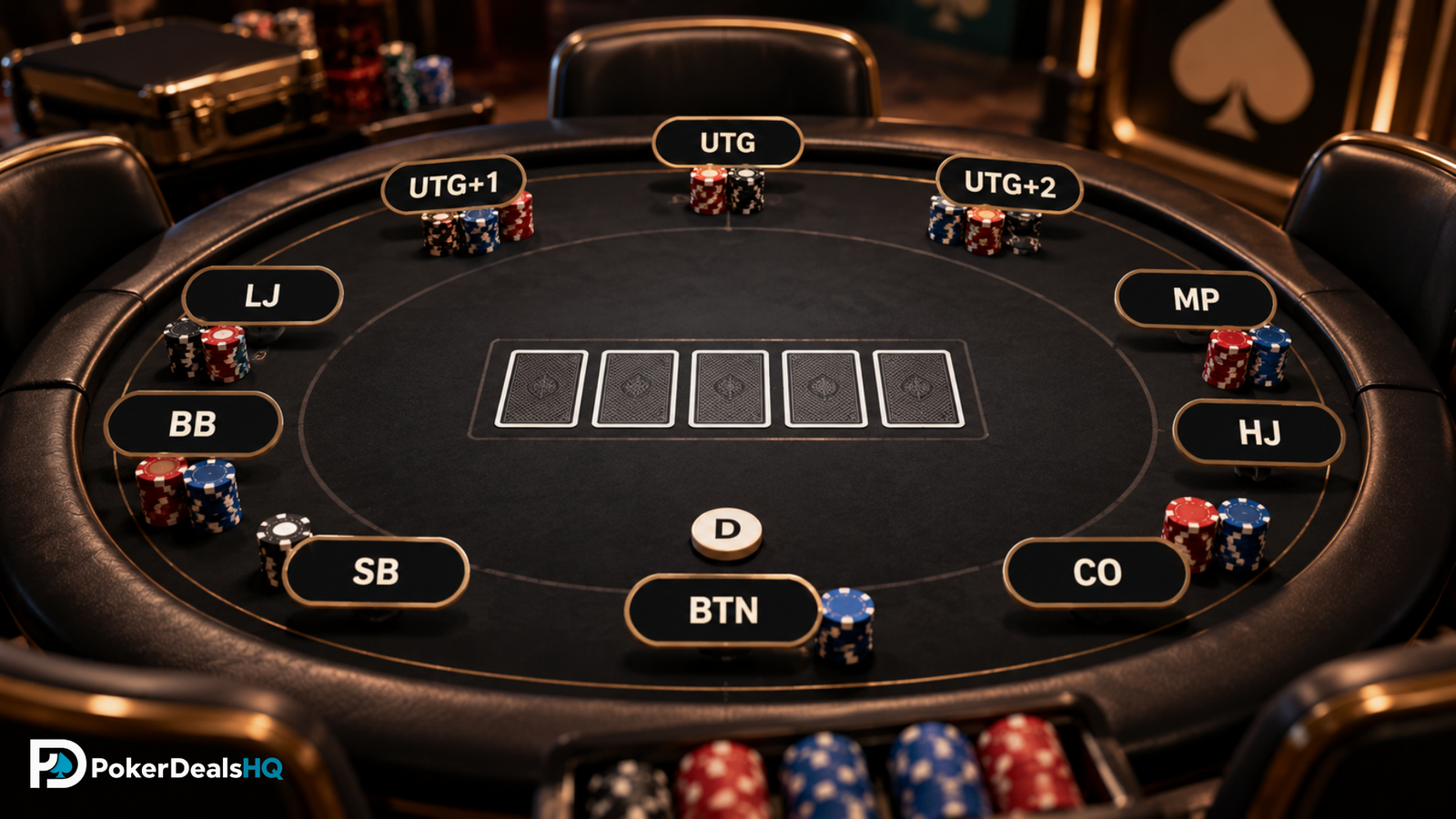
The order of play depends on each player’s poker position in relation to the dealer button. This also depends mostly on the number of players on the table. This description will outline the various positions in 6 and 9 player games, from the dealer position to the button and the blinds.
What Does Position Mean in Poker?
Your position tells you when it’s your turn to act. If you’re one of the first to act, you have to decide before most players. In the late position, you get to see what they do first.
The dealer button and the blinds determine your position. The button moves one seat clockwise after each hand. The small blind and big blind sit immediately to its left. Your poker table positions therefore change from hand to hand, even though you stay in the same seat.
The action order also changes with each betting round. Preflop, the player to the left of the big blind acts first, and the big blind acts last. On the flop, turn, and river, the first active player to the left of the button acts first. The button acts last if they are still in hand.
Poker Position Names at a 9-Max Table
A full-ring, or 9-handed, table has nine seats. The 9 max poker table positions are listed clockwise, starting with the small blind. Here are some common poker position names:
| Position | Abbreviation | Description |
| Small blind | SB | Posts the smaller forced bet; first to act after the flop |
| Big blind | BB | Posts the larger forced bet; last to act preflop |
| Under the gun | UTG | First to act preflop, directly left of the big blind |
| UTG+1 | UTG+1 | Next seat after UTG |
| UTG+2 / Middle position | UTG+2 or MP | Sits in the middle of the table |
| Lojack | LJ | Two seats before the cutoff |
| Hijack | HJ | Two seats to the right of the button |
| Cutoff | CO | Two seats directly to the right of the button |
| Button | BTN | The dealer seat acts last after the flop |
These seats are generally grouped into three zones. Early position includes UTG and UTG+1. The middle position covers UTG+2, the lojack, and the hijack, while the late position usually includes the cutoff and the button. The blinds are treated as a separate group because those players post forced bets and act in different spots during a hand.
The name poker hijack comes from the idea that a player in this seat can “hijack” the action by raising before the cutoff and button, putting pressure on them, and potentially taking control of the betting. Poker position names can vary slightly from one poker room to another.
Poker Positions at a 6-Max Table
The 6-max table has six seats, as the name suggests, so there are fewer 6-max poker positions. Here are some of the most common:
| Seat order | Position | Abbreviation |
| 1 | Under the gun | UTG |
| 2 | Hijack | HJ |
| 3 | Cutoff | CO |
| 4 | Button | BTN |
| 5 | Small blind | SB |
| 6 | Big blind | BB |
With fewer seats, there is no UTG+1 or separate middle-position seat. UTG is followed by the hijack, which some poker rooms may also call the lojack. Check the room’s terminology, since position names can vary. The seats still follow the same order around the table; it’s the labels that may change.
How 8-Handed and Short-Handed Tables Change Position Names
Position names depend on how many players are seated at the table. An 8-handed table has one fewer player than a full-ring table, so one middle-position label is usually dropped. A common layout for 8-handed poker positions is UTG, UTG+1, lojack, hijack, cutoff, button, small blind, and big blind. Some poker rooms may use different labels or omit UTG+1.
The same idea applies to any short-handed table. When a seat is empty, labels are usually dropped from the early positions first, while seats closer to the button—such as the hijack, cutoff, and button—generally keep their names.
Why Position Matters During a Hand
Acting later in a betting round can be an advantage if you like to gather information from the table. By the time you act, you may have seen whether your opponents checked or folded. If you act first, you have to make your decision before seeing what they do.
That’s one reason players pay attention to their position at the table. Position doesn’t guarantee anything: players can make good or bad decisions from any seat. Still, it can be useful to a more experienced player. As you get more comfortable, you may notice that the same situation can play out differently based on your position.
To see how action moves around the table during an event, check out our guide to how poker tournaments work.
Quick Reference: 6-Max vs. 9-Max Positions
The table below compares poker table positions at 6-max and 9-max tables. Each layout is listed clockwise, starting with the first player to act preflop.
| Preflop | 9-max position | 6-max position |
| 1 | UTG | UTG |
| 2 | UTG+1 | Hijack (HJ) |
| 3 | UTG+2 / MP | Cutoff (CO) |
| 4 | Lojack (LJ) | Button (BTN) |
| 5 | Hijack (HJ) | Small blind (SB) |
| 6 | Cutoff (CO) | Big Blind (BB) |
| 7 | Button (BTN) | n/a |
| 8 | Small blind (SB) | n/a |
| 9 | Big blind (BB) | n/a |
Regardless of table size, the hijack, cutoff, and button are generally considered late positions.
FAQ
What are the positions at a poker table?
The main poker positions include UTG, the middle seats, hijack, cutoff, button, small blind, and big blind. Which positions are present depends on how many players are seated at the table.
What is the difference between 6-max and 9-max poker positions?
A 9-max table seats up to nine players. When all seats are occupied, it includes early and middle positions such as UTG+1, UTG+2, and the lojack. A 6-max table has six seats and a shorter list of positions: UTG, hijack, cutoff, button, small blind, and big blind.
What does hijack mean in poker?
The hijack sits two seats to the right of the button, just before the cutoff. It is generally considered a middle or late position, depending on the table size and the terminology used.
Does your poker position change during a hand?
No. Your seat stays the same throughout the game, but your position changes. After each hand, the button moves one seat clockwise, so you’ll have a different position in the next hand.